Animals rescued by the NATUWA Wild Animal Center, Costa Rica.

The howlwer monkey in Costa Rica
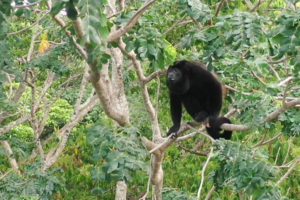
The howler monkey in Costa Rica: a howl for help at NATUWA Howler monkeys in Costa Rica and NATUWA’s workThe howler monkey in Costa Rica is known for a voice that carries far through the forest. At NATUWA in Aranjuez de Puntarenas, these calls are part of daily life. They also remind us of the wildlife that needs space to live and move. Our work combines emergency care, rehabilitation and habitat restoration. We receive howler monkeys injured by power lines, road traffic and dogs. At the same time, we restore forest cover and care for connections that wild animals use. This article brings together NATUWA’s experience with rescued animals and observations of a troop living freely in the sanctuary’s restored forest.The mantled howler monkey: Alouatta palliataThe mantled howler monkey, Alouatta palliata, is known in Costa Rica as the mono congo. Howler monkeys are a familiar part of the country’s wildlife. Their calls are often heard around dawn or dusk by people living near forest habitat. Howler monkeys occur in the forests of Central and South America. They live in socially organized groups and spend much of their time among the treetops. For example, they feed mainly on leaves, fruit and flowers. In this way, through their feeding and movement, they also contribute to the life of the forest, including seed dispersal. Therefore, learning about their behavior helps us understand why protecting forest habitat matters, both for individual monkeys and for the groups to which they belong. Infant howler monkey cared for at NATUWA · Archive 2017.Howler monkey sounds and habitat in Costa RicaHowler monkey sounds carry over long distances. Calls help members of a group communicate and can signal the presence of another group. A loud, prolonged call may have a different role from a shorter, softer sound. However, a howl alone does not tell us that an animal is injured or needs to be rescued. For example, at NATUWA, we have heard especially lively calling during rain, thunder and lightning, sometimes in the early morning. These are observations from life at the sanctuary. Listening encourages us to pay attention to what is happening around the troop without assuming that every call has the same meaning. In addition, we have observed high-pitched female calls during the dry-season months of January, February and March, alongside males shaking branches. The original account suggested a possible connection with reproductive behavior. These observations should be read as NATUWA’s interpretation, rather than a confirmed explanation of each call. Howler monkey habitat includes forests and wooded areas near human settlements. However, when tree cover becomes fragmented, moving between feeding and resting places can bring monkeys close to roads, power lines and dogs.A free-living troop at NATUWAThe troop described here lives freely in and around NATUWA. It is not a captive howler monkey attraction. These wild residents move through the trees and follow their own feeding, resting and social routines.For context, in the original 2024 account, NATUWA described a troop of about 30 individuals, with other troops…

Continue ReadingThe howlwer monkey in Costa Rica

Emerald toucan rescue

Aulacorhynchus prasinus or Emerald Toucan Toucan emerald, last Sunday, May 27, we received a call from a neighbor of the Miramar community of Puntarenas; He said that a toucanet chick had fallen from its nest and that they had been in their home for a few days. People decided that the best future for the bird was to try to return it to the ecosystem. So, they decided to enter the bird into NATUWA to rehabilitate it for its future release.   The emerald toucan (Aulacorhynchus prasinus) is one of the most beautiful birds in the rain forests; they inhabit the part of the canopy and edges of the forest; They can also be seen in cocoa plantations and even lightly wooded areas. In Costa Rica, it distributed at intermediate elevations along the Caribbean and Pacific slopes. NATUWA rehabilitates the bird so that it can return to its natural ecosystem. At this moment, it is in an enclosure full of vegetation that allows it to practice flight and even has the opportunity to search for food. The Aulacorhynchus is visited twice a day to be observed and to ensure that it is feeding and hydrating correctly.     Next, the bird will be under a process with as little human contact as possible to avoid imprinting. On the contrary, when the bird released, it will seek the company of someone and fall into the hands of someone who will not hesitate to subject it to conditions of captivity and food that are not very proper.

Continue ReadingEmerald toucan rescue

Orphaned mantled howler monkey (Alouatta palliata)

Read more about the article Orphaned mantled howler monkey (<i>Alouatta palliata</i>)
Mantled howler monkey

Officials from MINAE brought in a baby mantled howler monkey (Alouatta palliata). Local residents found her after learning that her mother had been killed by hunters and going to rescue her. Mantled howler monkeys feed on leaves and fruit, so they help disperse seeds in forests. However, they are hunted and sometimes kept as pets. Some people even hunt them for fun. The Sanctuary will provide her with appropriate care and management with a view to releasing her into the wild in the future. ———————————————————————————————— Calderón Soto Luis Mario. Natural Resource Management UNED, Costa Rica

Continue ReadingOrphaned mantled howler monkey (Alouatta palliata)

Zaino (Pecari tajacu)

Officials of the SINAC, enter a female zaino that was confiscated next to a female tepezcuintle, both animals were ready to be consumed as food by the human being. Now in the Sanctuary will receive all the necessary attention to live in environments full of vegetation and out of danger, away from those who want to use them as food.

Continue ReadingZaino (Pecari tajacu)

Tepescuintle Cuniculus paca

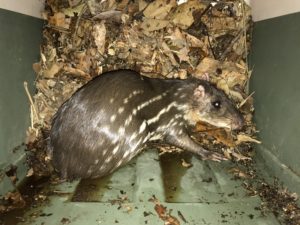
Rescue and Rehabilitation of an Injured Paca in the Natuwa SanctuaryThe Mission of SINAC and the Threats to WildlifeThe National System of Conservation Areas (SINAC) plays a crucial role in protecting the biodiversity of Costa Rica. One of its key responsibilities is to protect endangered species found in protected areas such as Carara National Park. However, despite their efforts, illegal hunting continues to be a persistent threat to wildlife in this protected zone.Rescue Operation: Saving a Paca from PoachersIn a remarkable rescue operation, SINAC officials successfully brought a female paca (Cuniculus paca) into the Natuwa Sanctuary. This particular animal had been targeted by illegal hunters who intended to sell it to the highest bidder for consumption. Fortunately, authorities intervened in time, preventing further harm to the defenseless creature.Evaluation and Rehabilitation: Assessing the Injury and Providing CareAfter the paca was rescued, SINAC officials observed an evident injury on one of its hind legs. Recognizing the importance of providing comprehensive care, they quickly organized a thorough evaluation to determine the extent of the damage. X-rays were scheduled to rule out possible fractures, ensuring that appropriate treatment would be administered.The primary focus now shifts to the rehabilitation process, where wildlife experts at the Natuwa Wildlife Sanctuary will work diligently to care for and recover the paca. The injured animal will receive specialized care, including medication, physical therapy, and a carefully planned diet to aid in its recovery. Once the paca has regained its strength and mobility, it will be released into its natural habitat, where it can contribute to conservation efforts in Carara National Park.In conclusion, the diligent efforts of SINAC officials have not only saved the life of a paca, but also highlighted the continued threats posed by illegal hunting. Through their rescue and rehabilitation operations, institutions like SINAC and sanctuaries like Natuwa are making significant strides in protecting Costa Rica's unique wildlife and preserving its natural heritage.Author: Rodolfo Orozco Vega, updated on June 20, 2023, 8:04pm.Visit our section of rescued animals at the following link: Natuwa Sanctuary Animals.

Continue ReadingTepescuintle Cuniculus paca

Cotorra (Amazona albifrons)

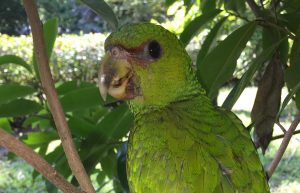
A juvenile of Cotorra (Amazona albifrons) entered the sanctuary of NATUWA parrots. This one was found by a person in the Center of Puntarenas and taken to the Coast Guard, the same one transferred it to the Sanctuary where it will receive the attention necessary to be released. It has the feathers of the wings cut, presents a very wild behavior, is not domesticated, which increases the possibilities of being able to integrate back to its natural environment, from which it never had to be extracted.

Continue ReadingCotorra (Amazona albifrons)

Racoon ( Procyon Procyon )

A Raccoon was brought to the Macaw Sanctuary NATUWA by the Puntarenas security forces. The animal was tied with a leash around its neck. Its captors did not perceive that the leash was causing harm, when in fact it produced very deep wounds. The raccoon will be released as soon as its wounds heal. A raccoon can present very aggressive behavior toward humans, for obvious reasons.

Continue ReadingRacoon ( Procyon Procyon )

White-faced monkey ( Cebus imitator )

On April 18 arrived a white-faced monkey (Cebus imitator), by officials of SINAC. The animal was the victim of humans who kidnapped it from the forest for use as a pet. Monkeys raised in our homes as pets become a terrible problem. They are animals that should be allowed to utilize their natural behaviors in the forest and not be surrounded by humans. In addition, they could be carriers of some kind of contagious disease and parasites affecting our families. Humans commit the action of removing animals from their natural environments to indulge in selfish pursuits. Now the monkey may have to live the rest of his life caged.

Continue ReadingWhite-faced monkey ( Cebus imitator )

Orange-chinned Parakeet (Brotogeris jugularis)

Monday night at about 7:00 pm arrived these three parakeets (Brotogeris jugularis) to the Macaw Sanctuary NATUWA. The Public Force from Esparza, from a seizure of these animals from a person carrying them on their motorcycle. The birds were only about three weeks of age and were found in a bag inside a squash. They will now be part of the breeding program here and will be eventually released by the Macaw Sanctuary NATUWA.

Continue ReadingOrange-chinned Parakeet (Brotogeris jugularis)