
The howlwer monkey in Costa Rica
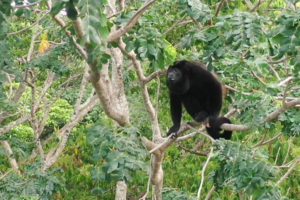
The howler monkey in Costa Rica: a howl for help at NATUWA Howler monkeys in Costa Rica and NATUWA’s workThe howler monkey in Costa Rica is known for a voice that carries far through the forest. At NATUWA in Aranjuez de Puntarenas, these calls are part of daily life. They also remind us of the wildlife that needs space to live and move. Our work combines emergency care, rehabilitation and habitat restoration. We receive howler monkeys injured by power lines, road traffic and dogs. At the same time, we restore forest cover and care for connections that wild animals use. This article brings together NATUWA’s experience with rescued animals and observations of a troop living freely in the sanctuary’s restored forest.The mantled howler monkey: Alouatta palliataThe mantled howler monkey, Alouatta palliata, is known in Costa Rica as the mono congo. Howler monkeys are a familiar part of the country’s wildlife. Their calls are often heard around dawn or dusk by people living near forest habitat. Howler monkeys occur in the forests of Central and South America. They live in socially organized groups and spend much of their time among the treetops. For example, they feed mainly on leaves, fruit and flowers. In this way, through their feeding and movement, they also contribute to the life of the forest, including seed dispersal. Therefore, learning about their behavior helps us understand why protecting forest habitat matters, both for individual monkeys and for the groups to which they belong. Infant howler monkey cared for at NATUWA · Archive 2017.Howler monkey sounds and habitat in Costa RicaHowler monkey sounds carry over long distances. Calls help members of a group communicate and can signal the presence of another group. A loud, prolonged call may have a different role from a shorter, softer sound. However, a howl alone does not tell us that an animal is injured or needs to be rescued. For example, at NATUWA, we have heard especially lively calling during rain, thunder and lightning, sometimes in the early morning. These are observations from life at the sanctuary. Listening encourages us to pay attention to what is happening around the troop without assuming that every call has the same meaning. In addition, we have observed high-pitched female calls during the dry-season months of January, February and March, alongside males shaking branches. The original account suggested a possible connection with reproductive behavior. These observations should be read as NATUWA’s interpretation, rather than a confirmed explanation of each call. Howler monkey habitat includes forests and wooded areas near human settlements. However, when tree cover becomes fragmented, moving between feeding and resting places can bring monkeys close to roads, power lines and dogs.A free-living troop at NATUWAThe troop described here lives freely in and around NATUWA. It is not a captive howler monkey attraction. These wild residents move through the trees and follow their own feeding, resting and social routines.For context, in the original 2024 account, NATUWA described a troop of about 30 individuals, with other troops…